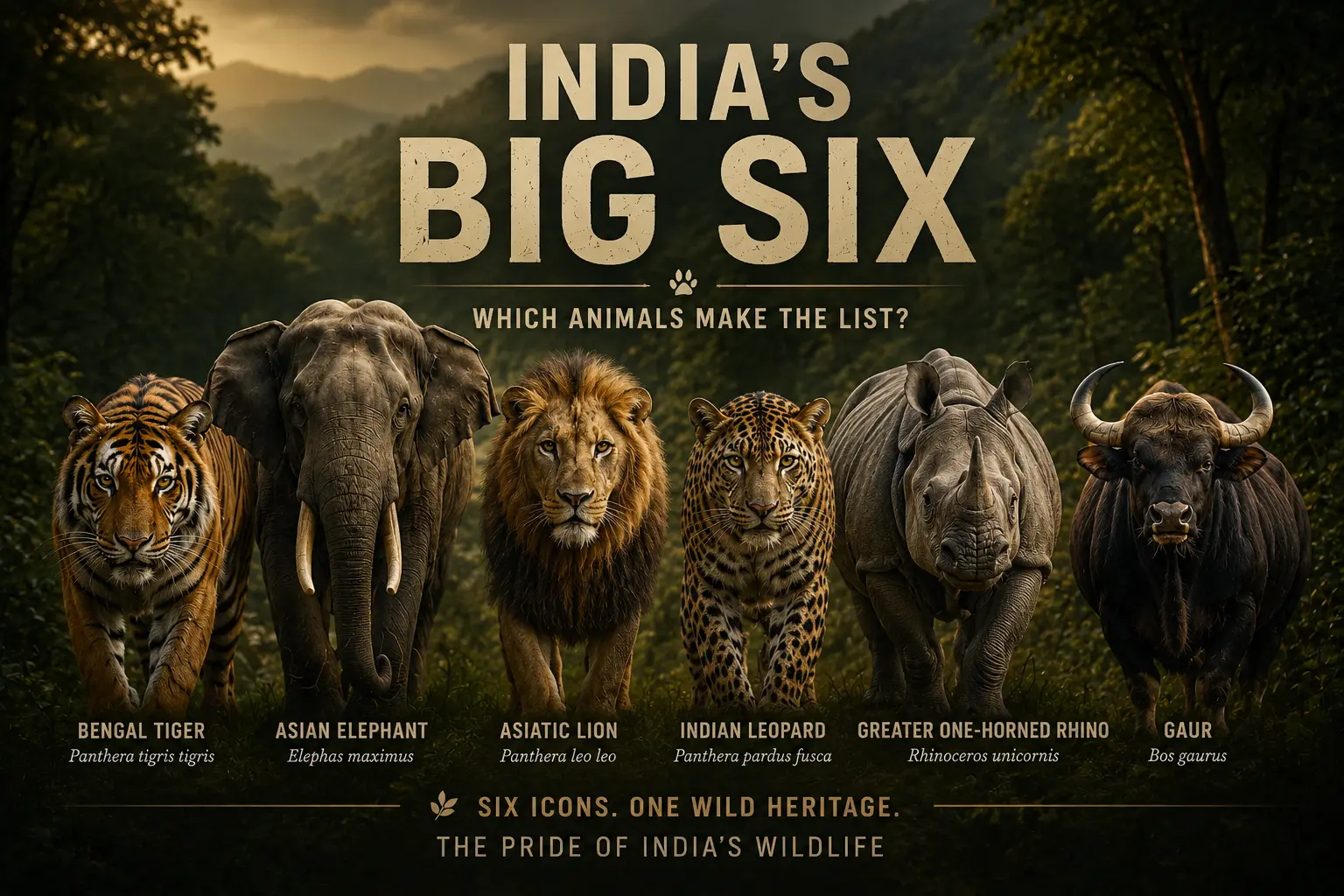


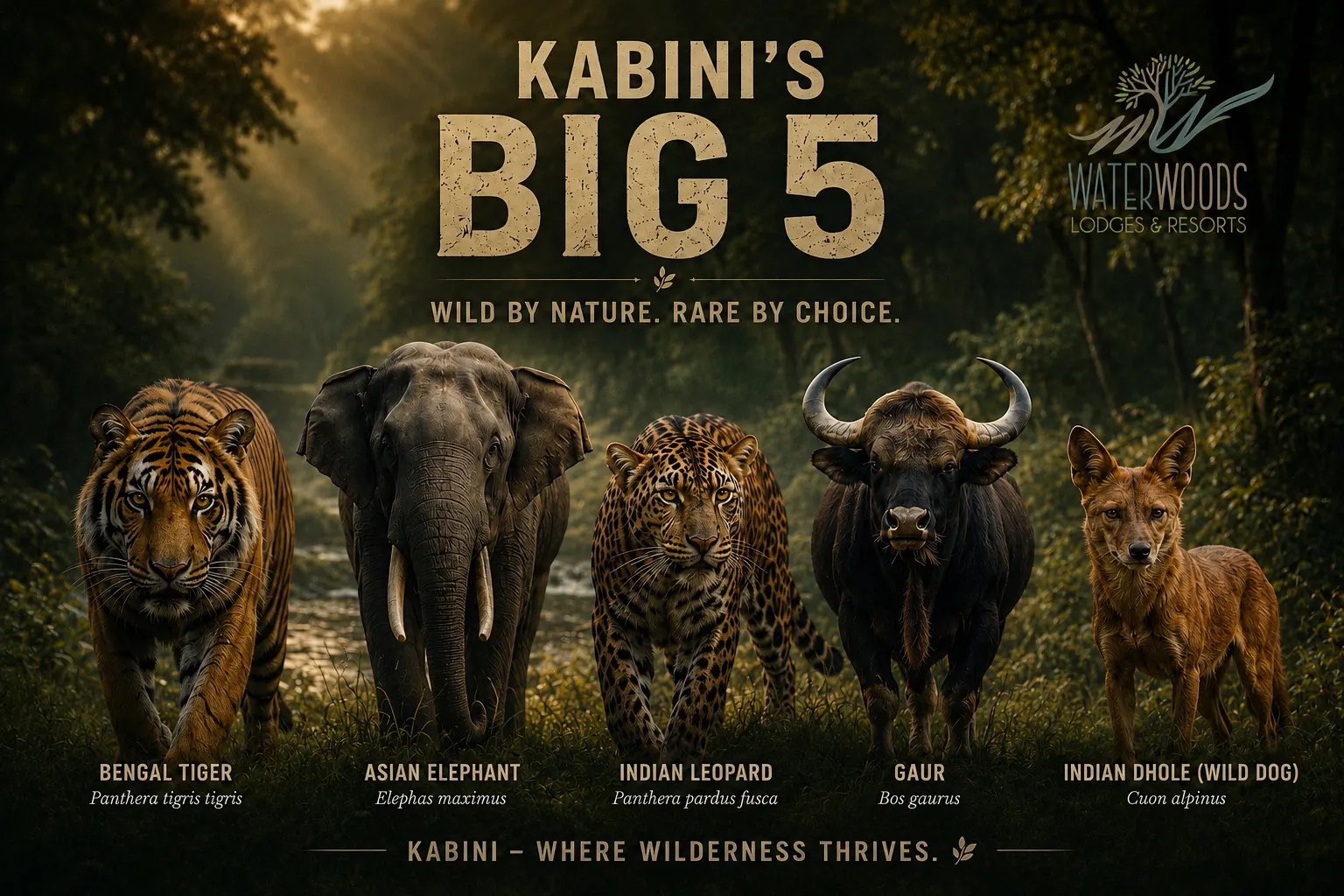
Africa’s “Big Five” was built on a hunting record from a century ago. Kabini’s version was built on something far simpler: five species that happen to share one river, one forest, and one safari route in the Western Ghats. A tiger, an elephant, a leopard, a gaur and a pack of dhole, each drawing wildlife travellers who could just as easily be booking a trip to the Serengeti instead.
Five species, five completely different survival strategies, one forest. Here’s who they are, what makes each one genuinely iconic, and what your odds actually look like on a Kabini wildlife safari.
What Is the Kabini Big Five?
Unlike Africa’s Big Five, which was born from hunting records, the Kabini Big Five grew out of something closer to observation. Guides, photographers and repeat visitors kept noticing the same five species turning up again and again as the animals people travelled for not because a committee decided it, but because the sightings data backed it up over years of safaris.
The big five of Kabini, Bengal tiger, Asian elephant, Indian leopard, gaur and Indian dhole represents something Africa’s original list never had to prove: five species that genuinely overlap in one landscape, visible from the same jeep, on the same morning, in the same forest. That’s rarer than it sounds. Most “Big Five” comparisons stitch together animals from opposite ends of a country. This one doesn’t have to.
The Forest Behind the List
None of this works without the terrain. Kabini sits inside Nagarhole National Park, on the southeastern fringe of the Nilgiri Biosphere Reserve. A stretch of forest connected to Bandipur, Wayanad and Mudumalai that lets wildlife move the way it’s supposed to, without hard borders. Locals and visitors alike often just call the whole stretch the Kabini nature reserve, and once you’ve spent a morning on the backwaters, it’s easy to see why the distinction between “park” and “reserve” stops mattering.
What sets it apart from a typical patch of Indian jungle is the Kabini River itself. As the reservoir shrinks through the dry months, it exposes wide grassy banks that pull animals into the open elephants wading in to drink, gaur grazing at the tree line, deer scattering as a predator gets too close for comfort. It’s the reason this stretch is routinely rated the best wildlife safari in South India, and arguably the best forest safari in South India for anyone chasing more than one species in a single trip.
Meet Kabini's Big Five
Bengal Tiger: The Apex Predator
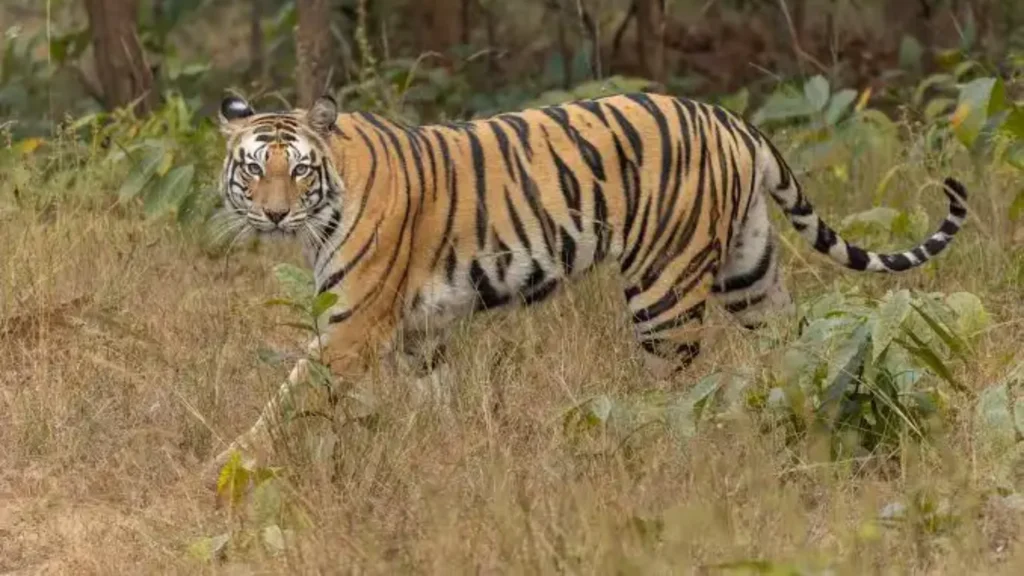
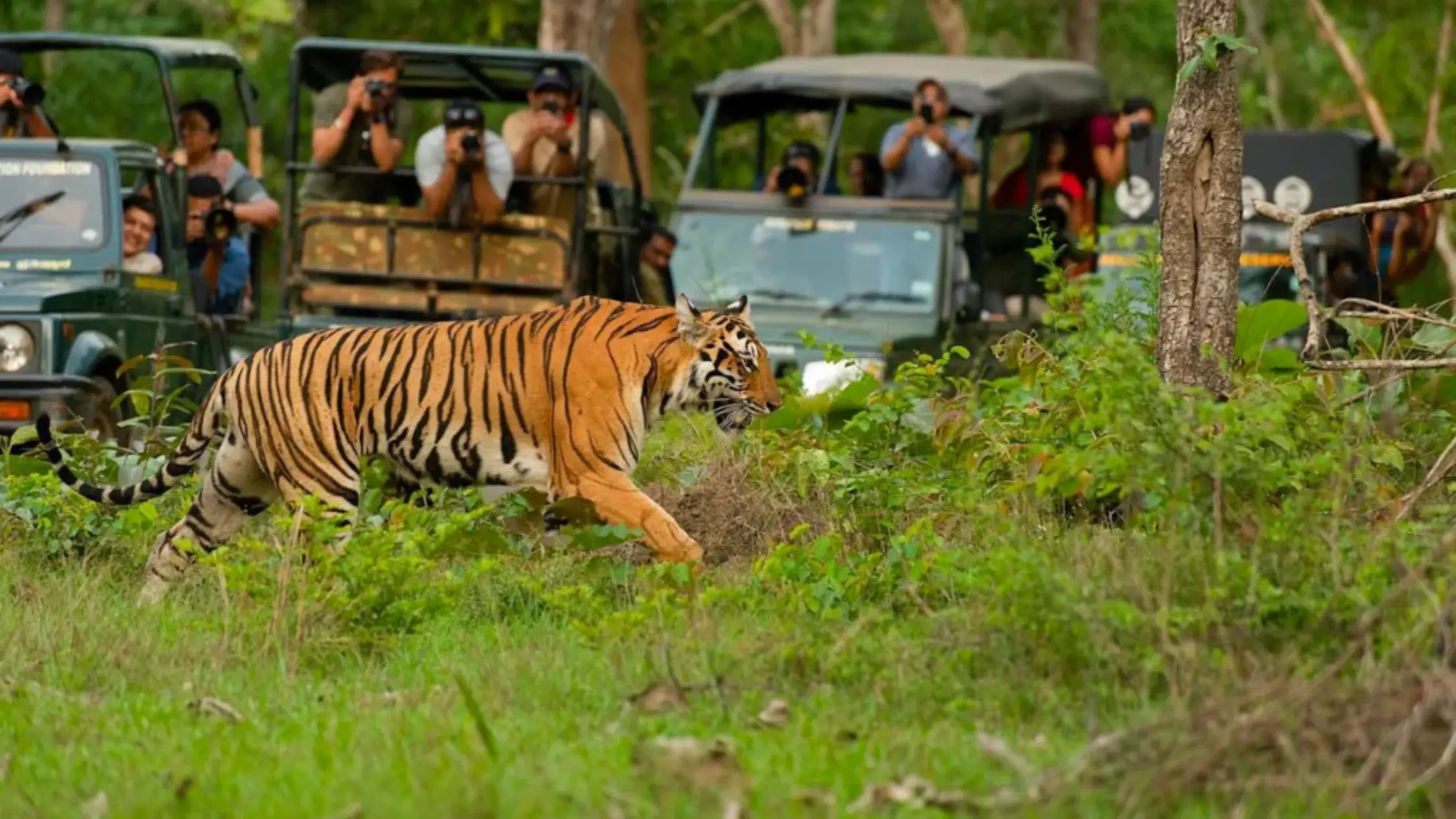
The tiger doesn’t need an introduction, but it earns one anyway. India now holds the majority of the world’s remaining wild tigers, and Karnataka’s forests, Nagarhole chief among them are some of the strongest tiger landscapes left standing anywhere. What makes a Kabini tiger sighting different from most Indian reserves is the terrain: instead of tracking a shape through dense teak, you’re often watching one cross open grassland near the water, unhurried, aware of exactly how visible it is and entirely unbothered by it.
Tigers here are solitary and fiercely territorial, requiring large, unbroken tracts of forest to hunt and raise cubs. They’re most active at first and last light, which is precisely when safari vehicles head out. Guides read the forest like a language alarm calls from langurs, fresh pugmarks in the mud along the shoreline long before the animal itself appears, if it appears at all. No safari can promise a tiger. But few Indian forests give you better odds of feeling like you nearly did.
Asian Elephant: The Gentle Giant of the Backwaters
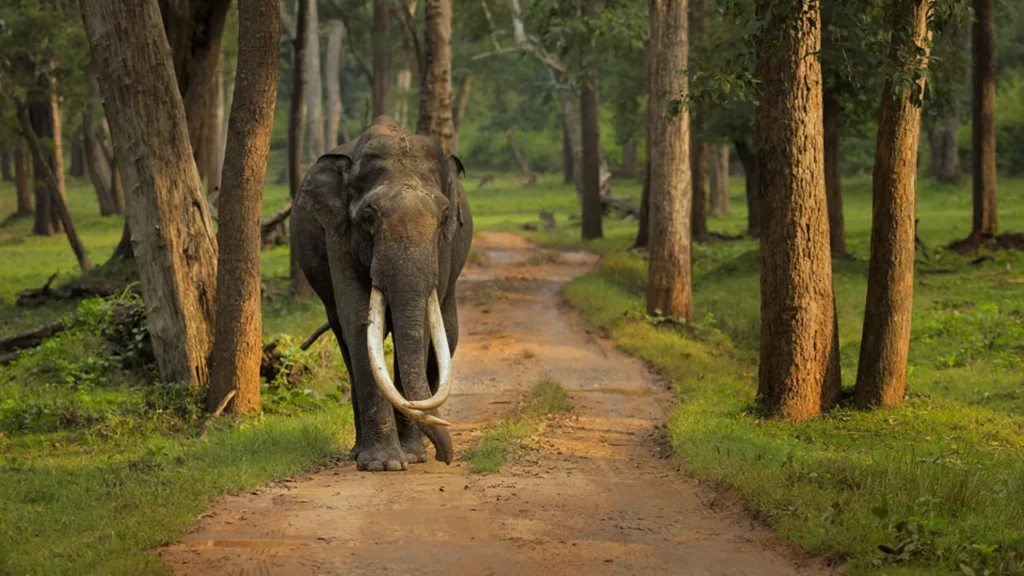
If there’s one species you’re almost certain to encounter, it’s this one. Karnataka carries the largest Asian elephant population of any state in India, and during the dry season, herds numbering in the hundreds converge on the Kabini backwaters one of the few places on the planet where free-ranging elephants, some carrying genuinely massive tusks, gather in numbers this visible.
Don’t mistake the calm for tameness. Elephants here are matriarch-led, deeply social, and capable of real aggression if a calf feels threatened or a herd feels cornered; guides give them a wide, respectful berth for good reason. Watching a herd move along the shoreline at sunset, calves tucked between adults, remains the single most reliable and most photographed moment on a Kabini safari.
Indian Leopard: The Ghost in the Trees
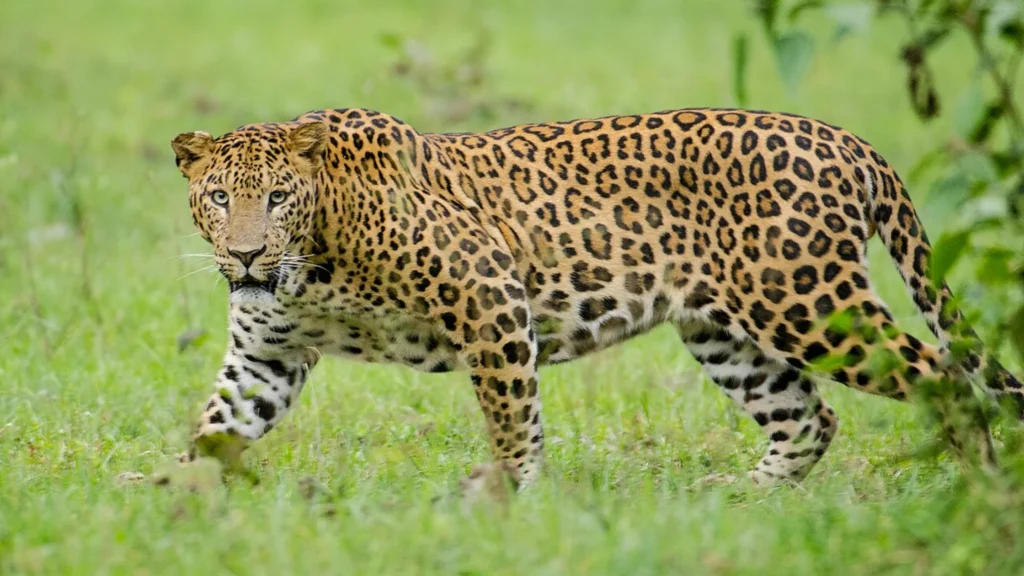
Leopards are everywhere in this forest and nowhere at once. Solitary, nocturnal, and built for camouflage rather than confrontation, they tend to work the forest edges here specifically to avoid competing with the tiger. Most sightings happen because a guide spots a tail hanging off a branch, or a silhouette draped across a limb in the mid-morning heat leopards are superb climbers and often rest well above eye level.
Kabini has one added claim to fame: it’s one of the few places in India where a melanistic leopard – a black panther, in the popular sense, has been reliably sighted over the years. It’s not a separate species, just an excess of dark pigment in an otherwise ordinary leopard, but the odds of seeing one are long enough that most guides treat it as a genuine bonus rather than an expectation.
Gaur: The Forest's Strongest Resident
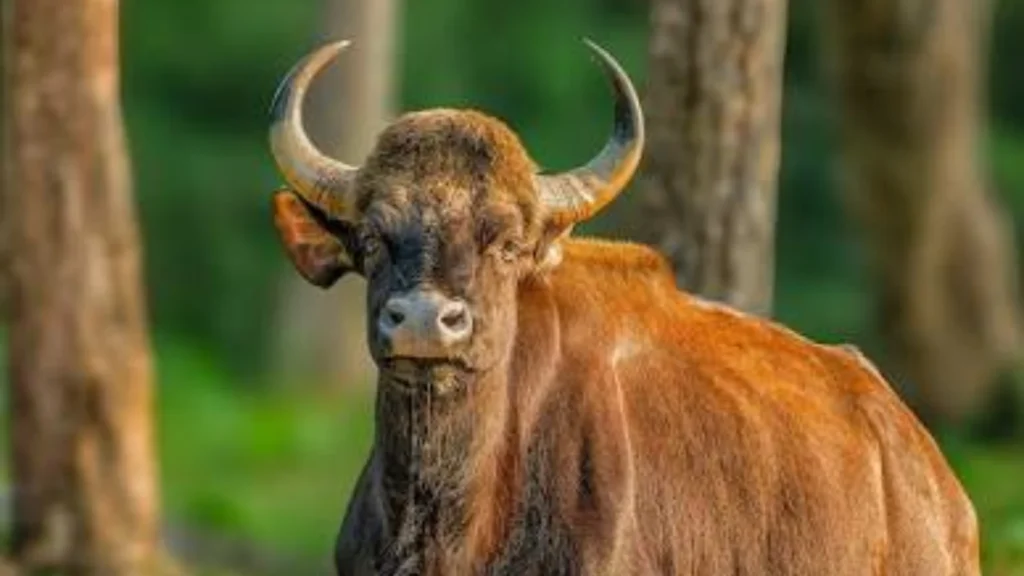
The gaur is the animal most visitors underestimate before they see one in person. As the world’s largest wild cattle species, a mature bull can weigh well over a tonne and stands taller at the shoulder than most safari-goers expect and there are recorded cases of gaur herds driving off tigers that got too close to a calf. Size alone makes it one of the forest’s more dominant presences, even though it’s a grazer, not a predator.
Herds tend to graze the open meadows near the backwaters in early morning and late afternoon, usually led by an older female, and melt back into the tree line the moment a vehicle gets too close for comfort. They’re shy for something so large which, if you think about it, is exactly the kind of contradiction that makes a good Big Five candidate.
Indian Dhole: The Pack That Punches Above Its Weight
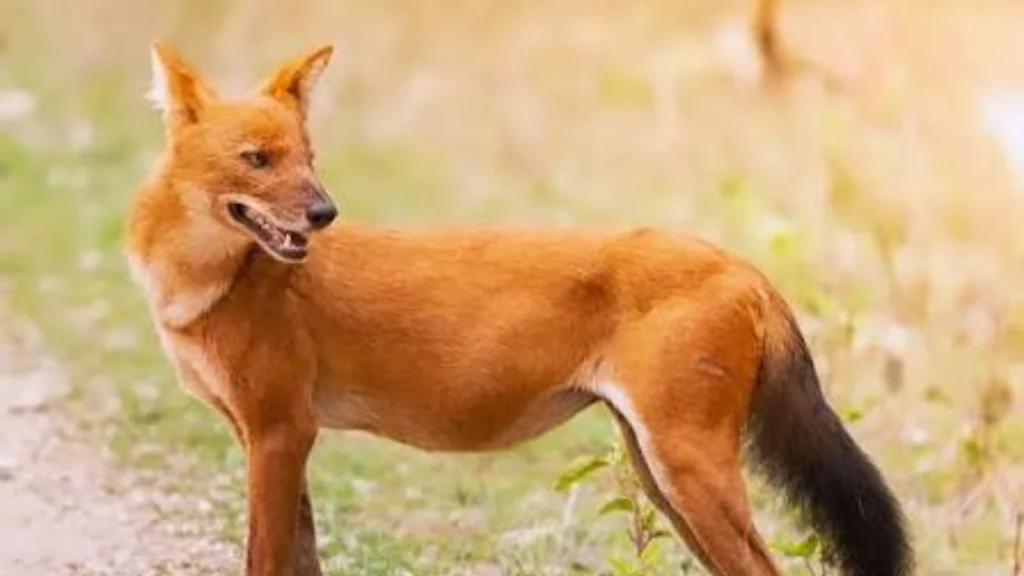
The dhole is the wildcard of the five, and often the most memorable sighting for visitors who’ve done a few Indian safaris already. Also known as the Indian wild dog, it hunts in coordinated packs of a dozen or more, using teamwork and endurance rather than brute strength a strategy effective enough to occasionally challenge a lone tiger over a kill.
They’re one of Asia’s most endangered canids, with fewer than a few thousand adults estimated to remain in the wild, which makes every sighting genuinely rare rather than just uncommon. Spot one dhole in Kabini and you’ll almost certainly spot the whole pack playing, resting, or moving together with the kind of coordination that looks almost choreographed from a distance.
How Africa's Big Five Was Actually Chosen
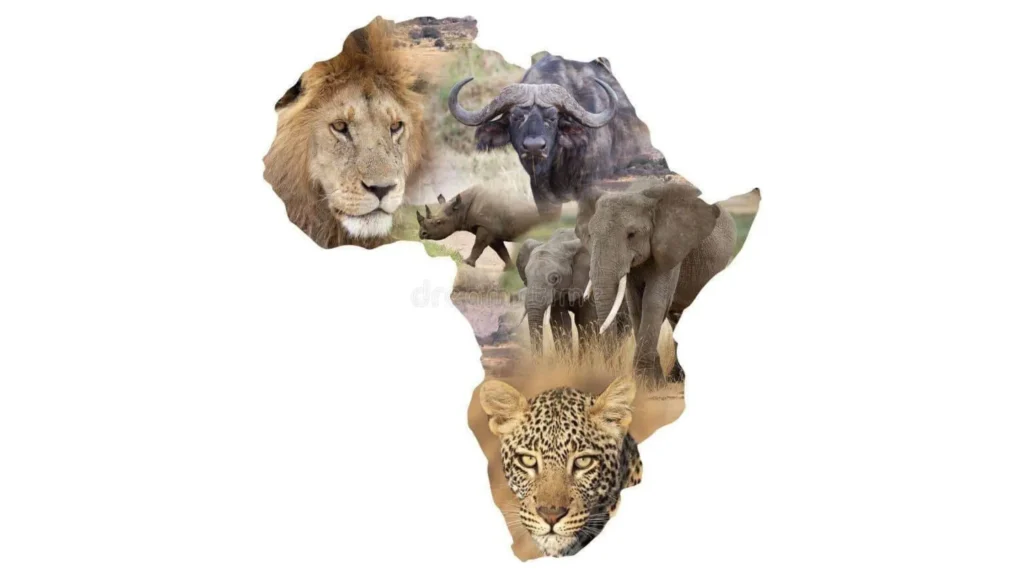
Lion, elephant, leopard, rhino and buffalo weren’t picked for size, beauty or how well they photograph. The label survives because each of the five clears the same five checks, the ones the chart below breaks down side by side:
- Global Iconic Status: Global charisma and recognition, the animals safaris, media and documentaries reach for first.
- Ecological Importance: A real, measurable role in ecosystem and biodiversity balance, not just visual impact.
- Wildlife Experience: High visibility and a strong probability of an actual sighting in the wild, not a rumour or a bucket-list long shot.
- Historical & Cultural Significance: Deep roots in heritage, folklore and the continent’s conservation legacy.
- Conservation Symbol: Standing as a flagship species that anchors real conservation funding and awareness.
Run Africa’s five through those checks and all five clear every one, which is exactly why the term has outlasted the colonial-era hunters who coined it. It’s also the same yardstick the chart uses to line India’s tiger up against Africa’s five, and on paper, the tiger clears every one of those checks too.
Africa's Near-Misses
Not every strong contender made the original five. The cheetah, hippopotamus, wild dog, giraffe and Nile crocodile all clear several of the same checks but fall short on at least one, usually visibility, fame, or the “fear factor” the list was built around. It’s worth remembering that India has its own version of this: the gaur, dhole and leopard all do serious ecological and cultural work without ever making it onto a five-animal shortlist.
Best Time for a Kabini Wildlife Safari
Kabini doesn’t have a single “best” month it has a best month for whatever you’re chasing. October through February brings cooler mornings and strong birdlife, as migratory species move in alongside residents. March through May, the dry stretch, is when the backwaters shrink fastest and elephants, gaur and tigers concentrate hardest around what water remains generally the most consistent stretch for big-mammal sightings all year.
Even the monsoon, when most Indian reserves close their core zones entirely, keeps Kabini open turning the forest a deep, saturated green and trading guaranteed sightings for a quieter, more atmospheric version of the same kabini wildlife safari.
Your Base for Kabini's Big Five

Seeing five species properly takes more than one good morning it takes proximity, timing, and a guide who knows this forest by its sounds as much as its sightings. Waterwoods sits directly on the riverfront, close enough to the safari gates that mornings start with the jungle rather than a transfer, while its remote forest villas at Swarajdeep offer a quieter, more immersive base for travellers who want the forest to feel less like a day trip and more like where they’re staying.
Think of this as your Kabini wildlife guide starting point not a promise of five sightings in five days, but a base built around giving you the best possible shot at all of them.
Final Word
Africa built an entire tourism industry on five animals sharing one idea. Kabini has its own five a tiger, an elephant, a leopard, a gaur and a pack of dhole, all genuinely sharing one river. You won’t see all five on your first safari. Most people don’t. But you’ll understand, within a single morning on the water, exactly why this list exists.
Frequently Asked Questions
What is the Kabini Big Five?
The Kabini Big Five refers to five iconic species that share this stretch of forest along the Kabini River: the Bengal tiger, Asian elephant, Indian leopard, gaur and Indian dhole. It’s an informal, guide-and-photographer-driven term, not an official wildlife classification, built around the animals travellers most consistently come here to see.
Why is Kabini wildlife famous in South India?
Kabini’s fame comes down to its river system. As the backwaters recede through the dry months, they draw elephants, gaur and tigers into open, visible terrain a rarity in Indian forests, where sightings usually depend on luck in dense cover. That, combined with strong tiger and leopard populations and over 250 recorded bird species, has made it one of the most talked-about wildlife destinations in the country.
Is Kabini wildlife safari worth visiting?
Yes, particularly if you want more than a single-species trip. Few Indian reserves offer this range of sightings big cats, elephants, gaur and dhole in one landscape, plus the option of a boat safari alongside the standard jeep safari, which most tiger reserves don’t offer at all.
Which animals can you see during a Kabini wildlife safari?
Beyond the Big Five, expect frequent sightings of spotted deer, sambar, langurs, bonnet macaques, crocodiles and a wide range of raptors and waterbirds. Gaur and elephant sightings are especially consistent near the backwaters; tiger, leopard and dhole sightings happen regularly but remain unpredictable by nature.
Why is Kabini considered one of the best wildlife safari destinations in South India?
It combines dense forest, a functioning river ecosystem, and genuine species diversity within one connected landscape the Nilgiri Biosphere Reserve. Add near-year-round access, when many other Indian parks close for monsoon, and it’s easy to see why it’s consistently ranked among the best wildlife safari options in South India.
What makes Kabini one of the best jungle safari experiences in South India?
The backwaters are the differentiator. They function almost like an African waterhole, concentrating multiple species in open view during the dry season something most jungle safaris in South India, run purely through dense forest, simply can’t replicate.
What is the best time to visit Kabini for wildlife sightings?
March to May offers the most consistent big-mammal sightings, as the shrinking backwaters concentrate elephants, gaur and tigers around the remaining water. October to February is cooler and excellent for birding. Kabini stays open through most of the year, unlike many reserves that close for monsoon.
Is Kabini suitable for first-time wildlife safari visitors?
Very much so. The combination of reliable elephant and gaur sightings, experienced guides, boat and jeep safari options, and comfortable riverside stays makes it one of the more forgiving entry points into Indian wildlife travel rewarding even on a first trip, without requiring the patience a purely tiger-focused reserve demands.